
When a new asphalt driveway or parking lot goes in, most owners watch the daytime forecast. The crew arrives, the trucks roll in, the hot mix goes down, and by evening the surface looks finished. But in cooler months, what happens after the crew leaves can matter just as much as what happened during the day.
Overnight temperature drops are a normal part of fall and winter in Texas, and they raise reasonable questions. Can a cold night damage fresh asphalt? How soon can you drive on it? Does the weather affect when it can be sealed or striped? This guide answers those questions in plain terms.
First, How Asphalt Actually "Sets"
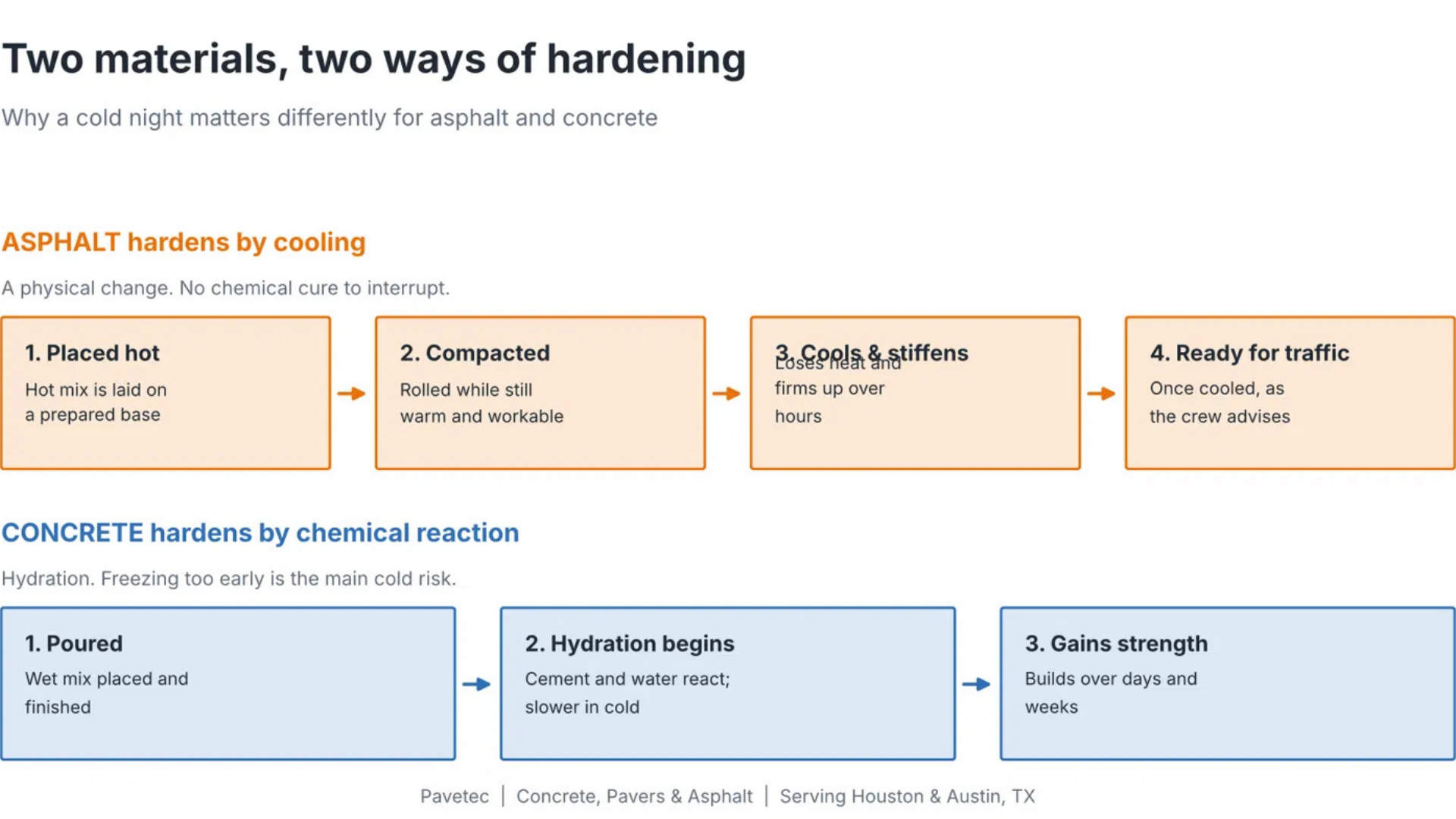
Asphalt doesn't cure the way concrete does. Concrete hardens through a chemical reaction that can take weeks. Asphalt hardens by cooling. It's placed hot, compacted while it's still warm and workable, and then it cools and stiffens as it loses heat.
That distinction matters for overnight temperatures. A cold night doesn't interrupt a chemical process in asphalt, because there isn't one to interrupt. What cold air mainly affects is how quickly the mat loses heat, and whether the crew got the density they needed before it did. Our article on what's actually in concrete vs. asphalt explains the difference in more detail.
The Real Risk Is Cooling Before Compaction
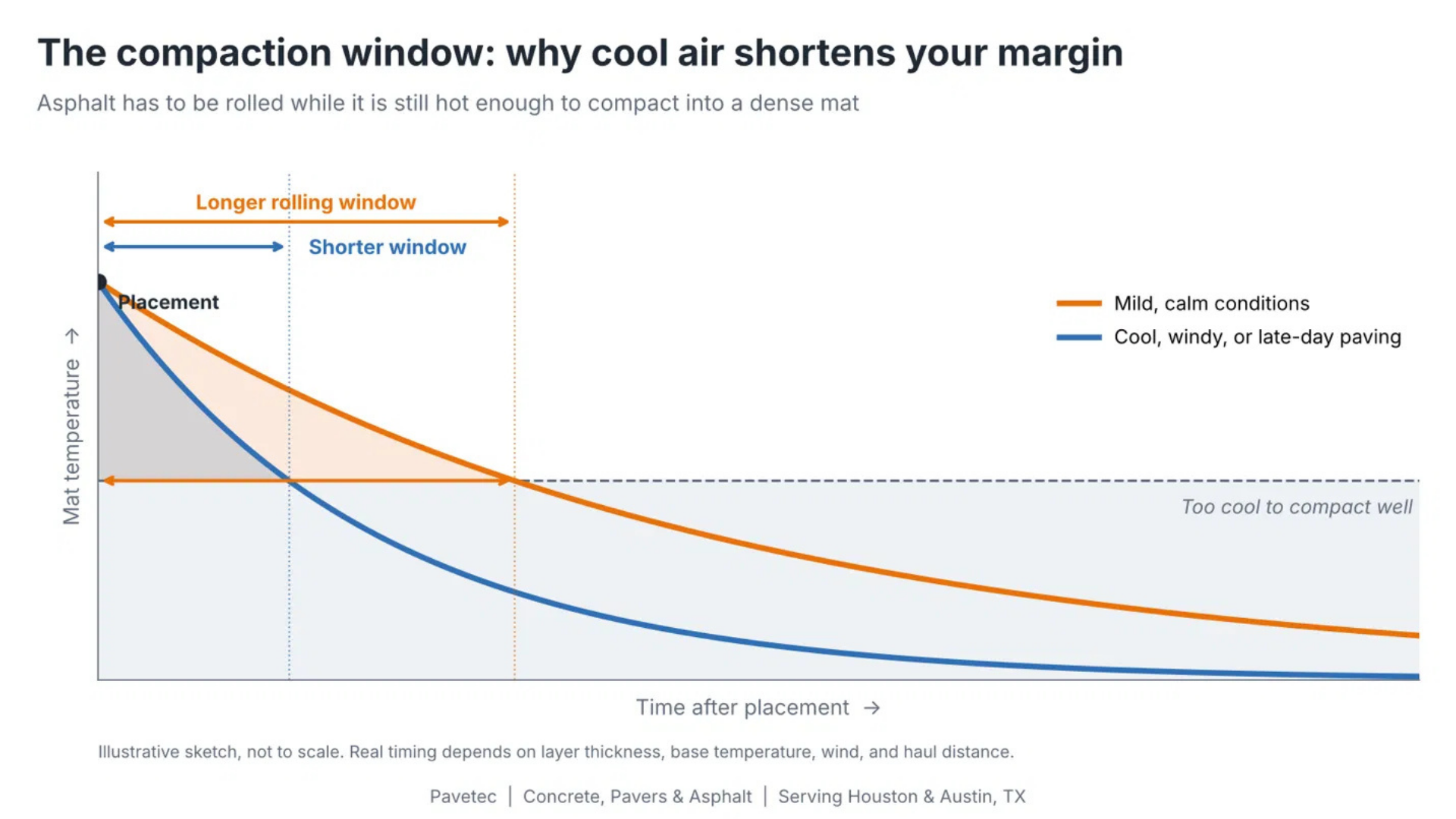
The most important window in the whole project is the period between placement and compaction. Asphalt has to be rolled while it's still hot enough to be pushed together into a dense, tight mat.
If cool air or a falling temperature causes the material to cool too fast, it can stiffen before it's fully compacted. The result is lower density, more air voids, and a surface that lets in water, oxidizes faster, and cracks earlier. Our article on why Texas roads and lots are so prone to potholes shows how those small weaknesses grow into bigger failures.
This is why timing matters in cool months. Late-day paving, when the temperature is already dropping, leaves less margin than a mid-morning start. Experienced crews often plan their day so that placement and rolling are finished while surfaces are still reasonably warm.
What Happens After the Crew Leaves
Once the asphalt is properly compacted, overnight cold is generally much less of a concern. The mat continues to cool and stiffen, and in cool weather it often becomes ready for light traffic sooner than it would in peak summer heat.
A few things are still worth knowing.
Cooling continues for hours. Even after the surface feels firm, the layer below can stay warm for a while, so heavy loads and sharp turning are best avoided at first.
Cool nights can follow warm afternoons. A surface that feels solid at dawn can soften slightly if the afternoon sun warms it, so the first day or two still call for care.
Dew and frost. Moisture on the surface overnight doesn't harm properly compacted asphalt, but it can make the surface slick and delay any follow-up work like striping.
Overnight Temperatures Before the Paving Starts
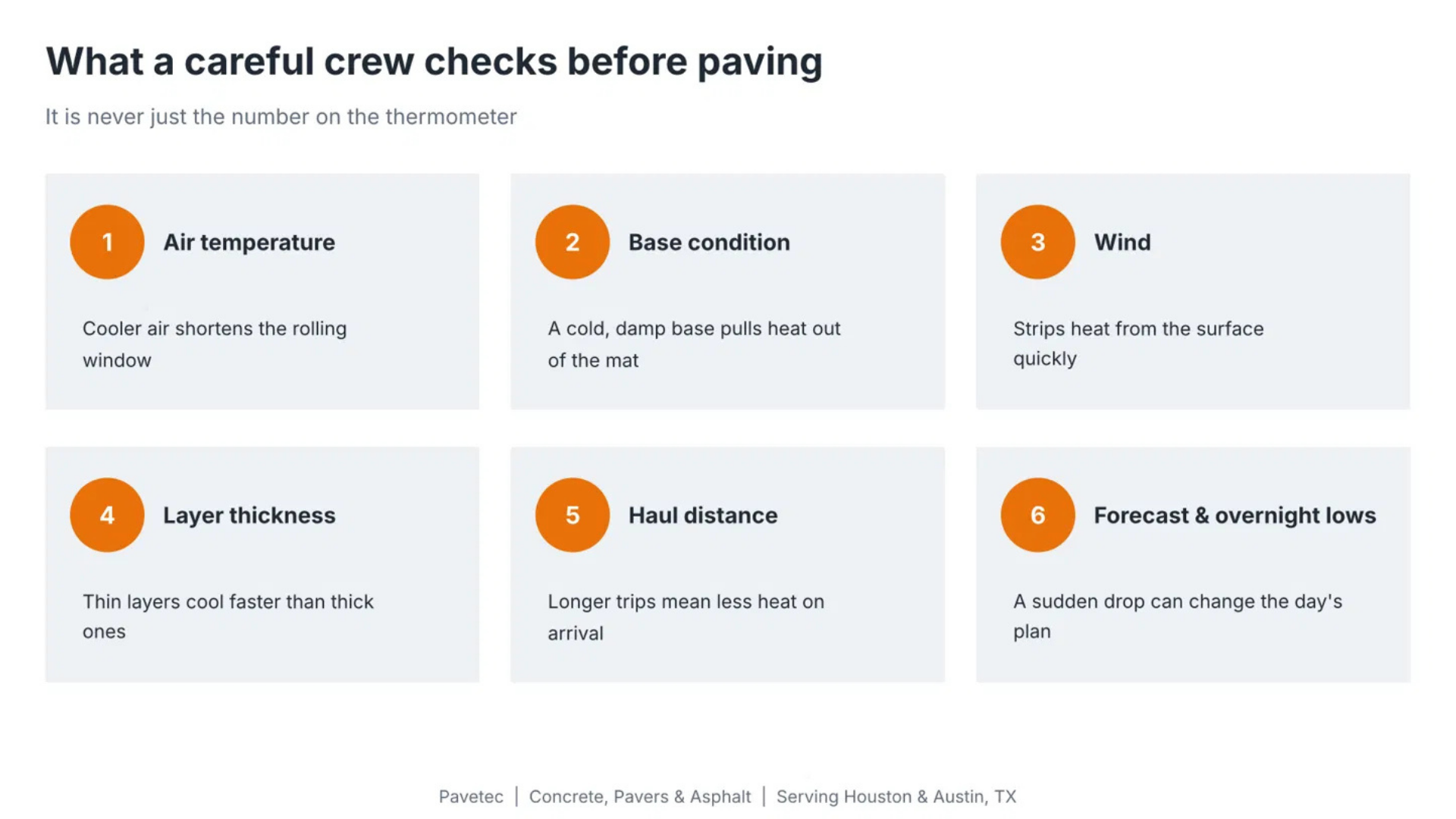
The night before paving can matter too. If the base is cold, damp, or frosty, it pulls heat out of the asphalt above it more quickly. Crews check the condition of the base, and they may delay a start until the ground has warmed up enough to avoid chilling the mix.
Wet or frosty conditions also affect the tack coat, the thin layer of asphalt emulsion used to help new asphalt bond to an existing surface during overlays. Cold, damp conditions can slow the time it takes to become tacky, which can weaken the bond. Our article on sealcoating vs. resurfacing vs. a full repave explains when an overlay is the right choice.
Joints Are the Weak Spot
Cool nights and falling temperatures affect joints more than the middle of the mat. Where one pass of asphalt meets another, or where new asphalt meets an existing edge, the material at the joint tends to cool faster and compact less thoroughly.
Poorly compacted joints are a common place for cracking and raveling to start. Good crews use techniques to improve joint density and take extra care during cooler conditions. For owners, it's a good question to ask a contractor how they handle joints when temperatures are marginal.
Sealcoating, Striping, and Other Follow-Up Work
Fresh asphalt has its own timeline for finishing touches.
Striping. Paint needs to dry and bond, and cool, damp nights can slow that. Contractors often wait for suitable conditions and may coordinate striping a short time after paving.
Sealcoating. New asphalt typically needs time to cure and weather before a first seal coat, often six months to a year. Overnight cold doesn't change that rule, but it can make the early months feel slow, and sealer applied in cool, damp conditions may not bond well. Our article on how often to seal coat an asphalt driveway in Texas covers the timing in detail.
Curb and edge work. Nearby concrete work has its own cold-weather considerations, covered in our article on how cold fronts affect fresh concrete in Texas.
Tips for Owners After a Cool-Weather Paving Job
Keep traffic off until the crew says it's okay. Ask for a specific time, since cooling depends on layer thickness and weather.
Avoid turning wheels while stationary. Even on cooled asphalt, sharp turns in place can scuff or mark the surface in the first days.
Watch for sun after a cold night. A warm afternoon can soften the surface somewhat, so use extra care.
Don't park heavy vehicles or equipment on it early. Kickstands, jacks, and trailer tongues can leave dents.
Keep an eye on drainage. Make sure water flows away from the surface, as covered in our article on why sub-base prep determines how long pavement lasts.
What Contractors Watch For
A careful asphalt crew monitors several conditions together, not just the number on the thermometer. They look at the air temperature, the surface temperature of the base, wind, layer thickness, and how far the material has to travel. They also keep an eye on the forecast, including National Weather Service updates for Houston and Galveston and Austin and San Antonio, because a sudden overnight drop can change a day's plan.
If conditions are marginal, a responsible contractor will tell you so and offer another date. Properly timed asphalt paving is worth a short delay, and the technical resources published by industry groups reflect how much compaction and temperature control matter to long-term performance. Our article on how weather delays affect paving timelines in Texas explains what to expect when schedules shift.
How This Differs From Concrete
If you're comparing materials, it helps to know the contrast. Asphalt's main cold-weather concern is cooling too fast before it's compacted. Concrete's main concern is freezing before it gains early strength. Our articles on paving in cool weather and on pouring concrete in November cover the concrete side in more detail.
Plan Smart With Pavetec
Overnight temperature drops don't have to threaten a new asphalt surface, as long as the work is planned around them. At Pavetec, we pay close attention to temperatures, base conditions, and compaction timing, and we'll tell you honestly if a date isn't right for your project.
📍 Proudly serving Houston & Austin, TX
Planning an asphalt driveway or parking lot this season? Let's find the right day.
📞 Contact us at (832) 674-3996 or message us to schedule your free consultation.